
Scientists have begged this question for millennia. Are we free beings whose actions birth from our various individualities or are we pre-programmed creatures of habit like every other inconsequential being on this planet?
As a personal opinion, I think it’s neither and both at the same time.
Biologically, we will always be animals; however, like all animals on this planet, we have a certain quirk; ours will be consciousness, which I think is through evolution. Just the same way some animals have special skills like flying, some animals can swim and some animals can breathe underwater.
This quirk, gift, some might say punishment, depending on your interpretation, puts an onus on us to consider our instinctual actions before we make them. And in that we are free. Free to choose fight or flight, to do or not to do.

This thought doesn’t claim that these 2 concepts; free will and instinct, are different, rather that humans have an ability to pause and reflect on those instincts before they act on them.
On one level, we have instincts; things we feel compelled to do without much thought. But on another level, we have self-awareness, which lets us challenge those instincts and make different choices. The tricky part is figuring out how much of our decision-making is truly “free” versus how much is just influenced by our environment, upbringing, and subconscious programming.
How much of our actions are determined by free will, or instinct. To better understand this let’s make a parallel. Person A grew up in a peaceful environment with loving parents and all of that, you know the nice stuff. Person B grew up in the slums, a real third world community where your safety is determined by the flip of a coin. Constant wars and all the terrible things that you can think of growing up in.
Like little lab rats let’s put them in a new environment completely alien to what they’re used to. Person A, in a robbery situation and Person B in the same situation. Person A is more likely to freeze in spot or run away without direction not because they wish to look stupid but their body is taking action (or in-action) on its own because the mind is running on instinct right now (free will has basically been turned off); they’re more or less running with airplane mode turned on, lol.
Meanwhile Person B is more likely to think of a contingency plan within the matter of seconds or milliseconds in some cases. Why? let’s talk about it.
Rinse and Repeat.
Person B has trained their instinct or has layered their instinct with free will through multiple encounters with reactionary situations. The body and mind adapt over time, so what might have once triggered a fight-or-flight response can eventually become something familiar—even if it’s something that would normally cause stress. People who grow up in chaotic environments often develop a kind of emotional numbness or desensitization, which can make them react differently than others in the same situation.
At the same time, this also means that free will isn’t just about the moment itself—it’s shaped by all the past experiences that trained us to react a certain way. It makes me wonder, how much of what we think is our “choice” is actually just conditioning? How much free will do we actually exercise?
This line of thought raises so many questions, is there such a thing as having more free will than another person? Is it something that we all have equally that is expressed in different ways?
For starters, free will cannot be measured with some mathematical equation neither is there a bar set that you must meet up to. Everyone born has free will, yes even mentally disabled people have free will. The actions we choose to make either with enough information or understanding of others and or ourselves will always be free.
However, I can understand the argument for the group.
The measure of free will is determined by how much you refine it. How much understanding of yourself and your actions do you have to make better free choices. The measure of free will can be determined by how much obligation have you placed on yourself to guide your actions according to a philosophy that is unique to you.
The more you define your free will; so to speak, the more you understand it, the better you understand yourself, and the more you begin to see the world through a different lens and understand that despite the fact that we are separate, we are all connected, and then you see the world in a much more much more holistic way.
Once you really understand your own free will, you start to see how everyone else is also acting from their own experiences, instincts, and choices. It kind of creates a sense of connection, even in individuality.
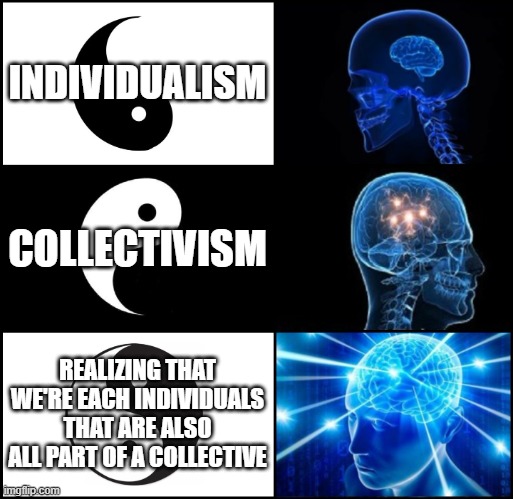
It’s interesting because that means free will isn’t just about making choices—it’s also about awareness. The more you understand yourself, the more you understand others, and that changes how you interact with the world. It’s almost like true free will isn’t just about choosing but about seeing—seeing things for what they are instead of just reacting to them.
To wrap this up, we need to start seeing clearly and thoughtfully. To start making connections with everyone around us. All of this will enable us to attain true freedom, true free will.
Rogue.

Leave a Reply